
What’s In This Guide
- Why Is AI Search Optimization Becoming More Important Than Traditional Search Rankings Alone?
- What Is Generative Engine Optimization And How Does It Differ From SEO?
- What Signals Help Improve LLM Visibility Across AI Search Platforms?
- How Can Businesses Earn More AI Citations?
- Which Common Mistakes Reduce AI Search Visibility?
- How Can Businesses Measure Success Beyond Traditional Rankings?
- Frequently Asked Questions (FAQs)
AI-powered search has changed how users discover business information online. ChatGPT, Gemini, Perplexity, and Google AI Overviews often summarize answers before users click a result. Businesses need content that AI systems can understand, verify, summarize, and cite. Strong AI search optimization, generative engine optimization, LLM visibility, and citation-ready content help support that goal.
Quick Facts
- AI search optimization helps businesses appear in AI-generated answers, not just traditional search rankings.
- Generative engine optimization makes content easier for ChatGPT, Gemini, Perplexity, and Google AI Overviews to understand and cite.
- Strong LLM visibility depends on clear entities, answer-first sections, internal links, FAQs, and updated source-backed content.
- AI citations cannot be guaranteed, but clear structure, credible evidence, and expert-reviewed content improve citation potential.
- Corporate video content supports AI search when paired with transcripts, summaries, captions, and optimized supporting copy.
Why Is AI Search Optimization Becoming More Important Than Traditional Search Rankings Alone?
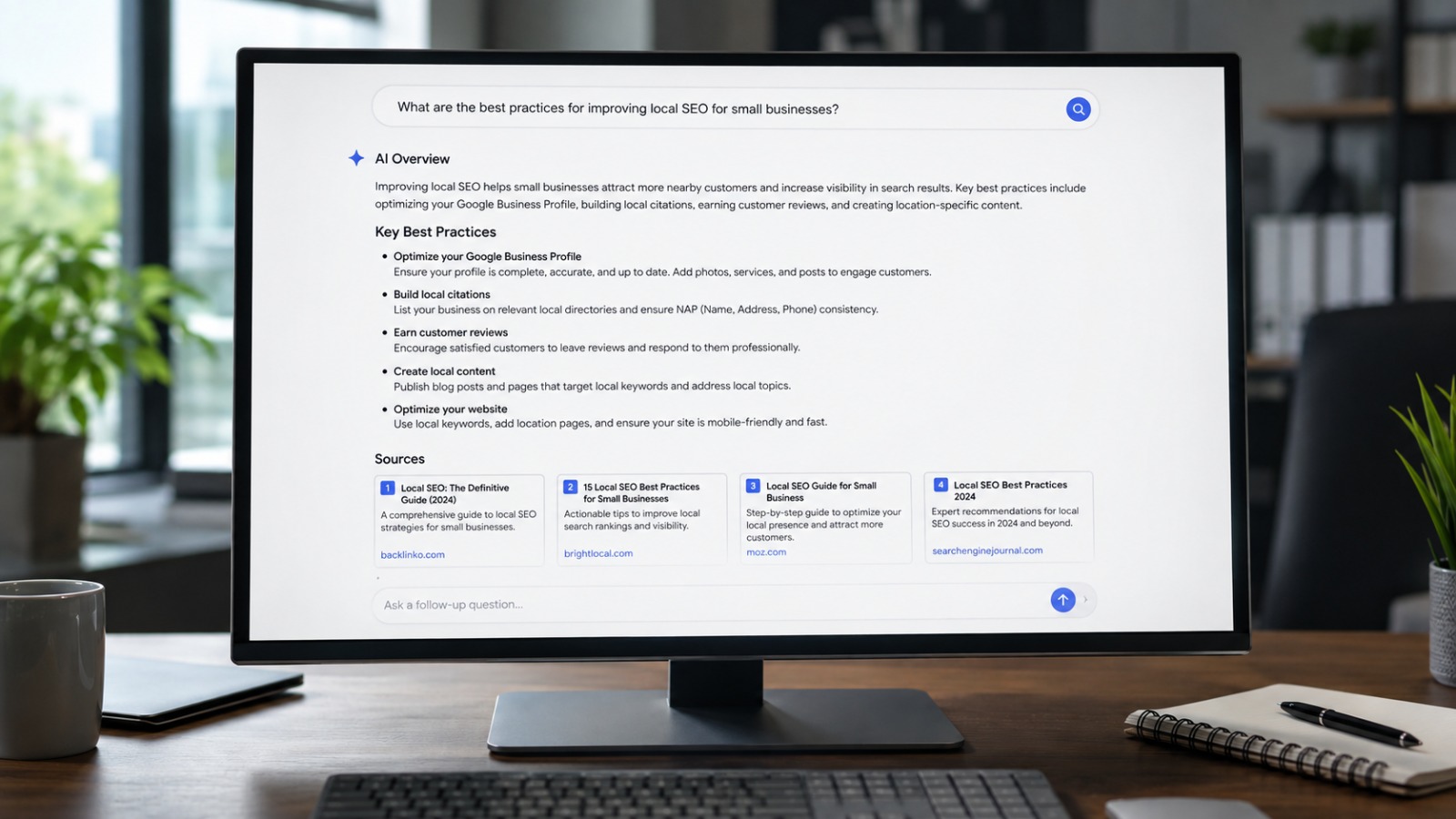
AI search optimization helps businesses appear in AI-generated answers, not just traditional search results. Rankings still matter, but AI tools now summarize trusted content directly. Business content must answer questions clearly, prove claims, and connect entities across the website.
Traditional SEO focuses on search visibility and clicks. AI search optimization also focuses on machine comprehension, topical confidence, and citation readiness.
|
Traditional SEO Focus |
AI Search Optimization Focus |
|
Keyword rankings |
Answer extraction |
|
Title tags and meta descriptions |
Structured summaries |
|
Backlinks |
Trust and corroboration |
|
Individual pages |
Connected topic clusters |
|
Organic clicks |
AI citations and brand mentions |
AI tools look for content that reduces ambiguity. A business page should clearly state who the company serves, what the company offers, where the company operates, and why the information can be trusted.
AI-friendly content should connect corporate video services with business outcomes such as training, recruiting, sales enablement, brand messaging, and internal communications.
What Is Generative Engine Optimization and How Does It Differ From SEO?
Generative engine optimization improves how AI platforms understand, summarize, and cite content. SEO helps search engines rank pages. GEO helps AI tools extract accurate answers from those pages.
Generative engine optimization does not replace SEO. GEO builds on SEO by making content easier for answer engines to use.
Core GEO priorities include:
- Clear definitions near the top of sections.
- Short factual answer blocks.
- Entity-rich wording.
- Structured data that matches visible content.
- Tables, steps, FAQs, and comparison formats.
- External citations from neutral, authoritative sources.
Google’s structured data documentation explains that markup should accurately represent visible page content. This helps search systems better understand the page and supports clearer machine-readable context for AI-assisted search.
What Signals Help Improve LLM Visibility Across AI Search Platforms?

Better LLM visibility comes from entity consistency, answer-first writing, source-backed claims, and complete topic coverage. AI tools need enough context to understand what a business knows and where that expertise applies.
LLM visibility depends on how easily AI systems can connect information across a website. One isolated blog post rarely builds enough authority. A connected library of helpful content performs better.
Useful visibility signals include:
- Consistent company name usage.
- Clear service descriptions.
- Author or editorial review details.
- Internal links to related resources.
- FAQ sections that answer real user questions.
- Updated statistics and references.
- Schema markup for articles, organizations, FAQs, and videos.
How Can Businesses Earn More AI Citations?
AI citations are influenced by trust, clarity, usefulness, and source quality. No business can guarantee AI citations, but businesses can improve citation potential by publishing accurate, structured, source-supported content.
AI citation potential improves when content answers a question clearly, directly, and with stronger support than competing pages. The page should provide a direct answer, supporting details, and reliable evidence without unnecessary sales language.
Citation-ready content often includes:
- Definitions written in plain language.
- Step-by-step processes.
- Comparison tables.
- Current facts with credible references.
- Clear author or editorial ownership.
- Internal links to related authority pages.
- Original examples from real service experience.
Google’s helpful content guidance emphasizes people-first content, original value, and reliable information. Those principles also support generative engine optimization because AI tools need content that can be summarized without distortion.
MORE ON THIS TOPIC: How to Use AI to Improve Your SEO Results in 2026
Which Common Mistakes Reduce AI Search Visibility?

Weak content structure, vague claims, outdated information, and inconsistent business details reduce AI confidence. AI tools need clear, verifiable, and well-organized content before citing a source.
Common mistakes include:
|
Mistake |
Better Approach |
|
Keyword stuffing |
Natural keyword integration |
|
Thin explanations |
Complete answer blocks |
|
Unsupported claims |
Source-backed statements |
|
Vague business references |
Clear named entities |
|
Outdated statistics |
Regular source reviews |
|
Long text blocks |
Lists, tables, and short paragraphs |
|
Generic AI copy |
Expert-edited content |
Human editorial review remains important. AI drafting tools can speed up content production, but subject matter expertise protects accuracy. Editorial review also improves E-E-A-T signals by confirming that the content reflects real business knowledge.
For Corporate Video Production, weak content might list “video services” without context. Stronger content explains video goals, production stages, creative strategy, distribution use cases, and measurable business applications.
How Can Businesses Measure Success Beyond Traditional Rankings?
Businesses should measure AI visibility through brand mentions, AI citations, referral traffic, engagement, and conversions. Ranking reports alone do not show how often AI tools summarize or reference a business.
Useful measurement signals include:
- Branded search growth.
- Organic traffic quality.
- Engagement on educational pages.
- Conversions from service pages.
- Referral traffic from AI platforms.
- Mentions in AI-generated answers.
- Increased impressions for question-based searches.
Google Search Console can show queries, impressions, clicks, and page performance. Analytics platforms can show engagement and conversions. AI visibility tools can help monitor brand mentions across generative platforms, although measurement methods are still developing.
Businesses should treat LLM visibility as a long-term authority metric. Strong visibility grows from consistent publishing, accurate information, technical clarity, and content that directly answers user questions.
Frequently Asked Questions (FAQs)
Can small businesses benefit from AI search optimization?
Yes. Small businesses can improve visibility by publishing clear, accurate, and well-structured content that answers customer questions and demonstrates expertise.
Does video content help with AI search optimization?
Yes, when supported by transcripts, summaries, captions, and descriptive page content. AI systems rely on text to better understand video content.
What types of content can support AI citation potential?
Guides, FAQs, comparison pages, how-to articles, and original research can support AI citation potential when they provide direct, well-supported answers.
How does internal linking improve LLM visibility?
Internal linking improves LLM visibility by connecting related topics, helping AI systems better understand a website’s expertise and content relationships.
Should businesses create separate content for AI search and traditional SEO?
No. One well-written, people-first page with clear structure, credible sources, and helpful answers can support both traditional SEO and generative engine optimization.
Strengthen Your AI Search Strategy With Corporate Video Production
Corporate Video Production helps businesses create professional video content that supports AI-ready written content. Pairing high-quality videos with transcripts, summaries, captions, and optimized supporting copy can make content easier for people and AI-powered search platforms to understand.